
Get involved

We monitor thousands of news stories across TV, print and social media, run the Real411, MARS, KnowNews and PADRE platforms, and chair a cross-sector disinformation working group — turning evidence about what is true, false or manipulated into action that regulators, platforms, journalists and the public can use.

From strategic litigation defending journalists against SLAPP suits to policy submissions on platform accountability, we push for a media and information environment that is transparent, diverse, and accessible to the public.

Through Web Rangers, MARS and our work with the South African Human Rights Commission and other partners, we help children, journalists and human rights defenders navigate digital spaces safely — responding to online harms with rapid, rights-based interventions.
Where our monitoring, litigation, tools and training have changed outcomes.

In June 2025, as a xenophobic-violence court case against Operation Dudula drew national attention, members of the movement began posting incitement to violence online, including plans to target judges and legal teams at their homes. Real411 processed the urgent reports and referred them to the South African Human Rights Commission in under five hours. The SAHRC alerted the police and issued a public statement; the planned violence did not take place.
“A positive model of State and civil society partnership to tackle disinformation while respecting human rights — a portal for the public to report online harms, with independent experts to assess complaints, transparency and an appeal system.”
Irene Khan, UN Special Rapporteur on Freedom of Opinion and Expression

The Commission’s final report on the Media and Digital Platforms Market Inquiry adopted a rights-based framing that Moxii Africa and the SANEF consortium had argued for from the outset — including specific references to children’s rights and, notably, our proposal for an independent Online Information Ombud, an idea also picked up in the DCDT’s draft white paper.

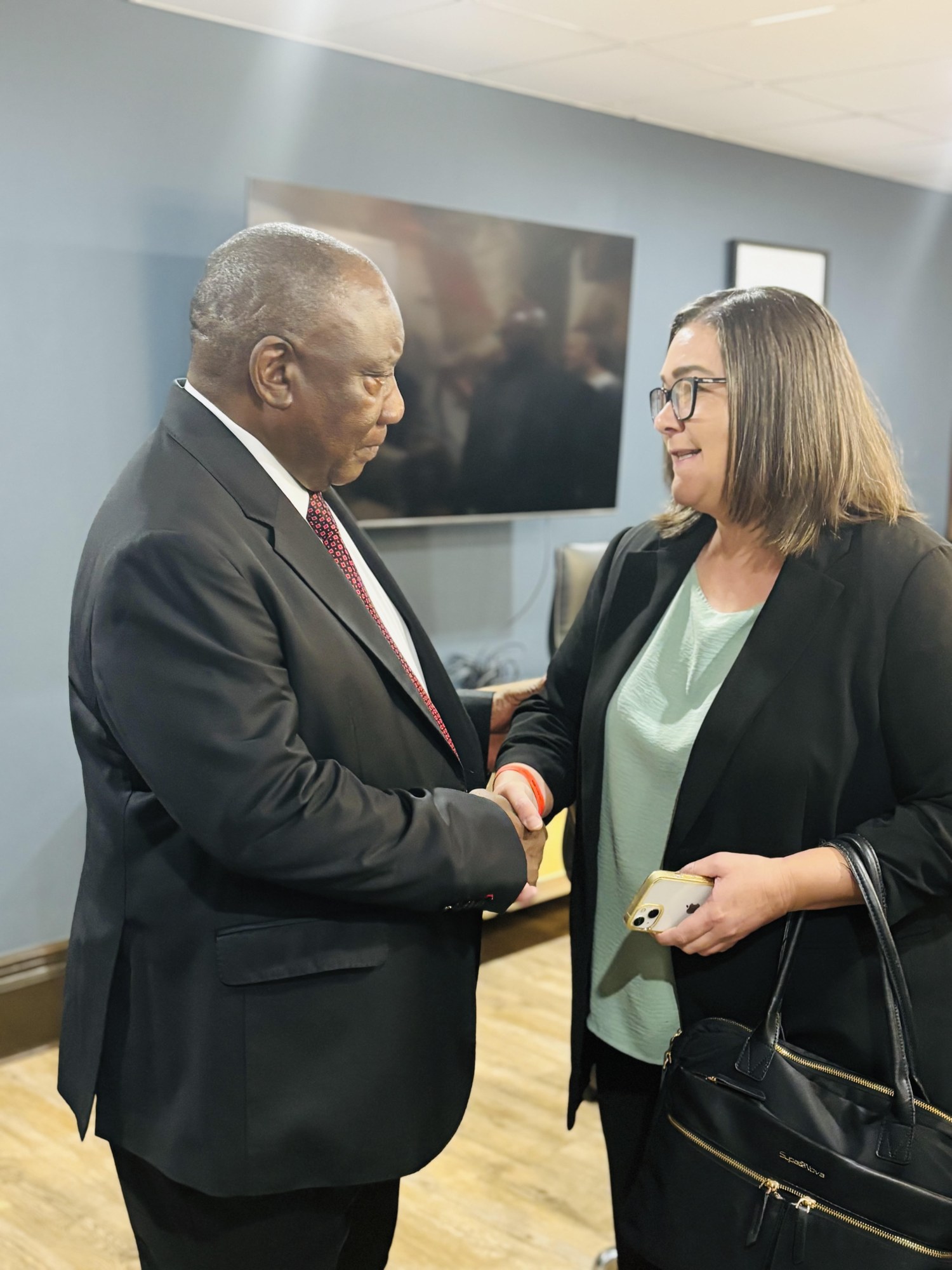
In 2025, Moxii Africa and the South African National Editors’ Forum launched the Media20 (M20) to place information integrity, AI, media viability, journalist safety and gender justice on the global G20 agenda. The M20 Summit in Johannesburg produced the Johannesburg Declaration, endorsed by close to 80 organisations, which William Bird and SANEF chairperson Makhudu Sefara handed to President Cyril Ramaphosa ahead of the G20 Leaders’ Summit.

“Media freedom sits at the heart of democracy and needs to be fiercely protected and promoted. In an ever-evolving technology environment, it is important that we critically unpack the ramifications these have for media.”
William Bird, Director, Moxii Africa

As one of South Africa’s most active civil society litigants, Moxii Africa has acted as amicus curiae in landmark cases protecting journalists from SLAPP suits (Mazetti v amaBhungane; Maughan v Zuma), defending public participation in Chapter 9 appointments, and addressing online hate speech.
“Our digital age may pose new forms of harm, but it calls for the same judicial virtues of clarity, context, and courage. Moxii Africa’s Judicial Handbook is a welcome, rich resource in this new and ever-evolving field.”
Justice N Majiedt, Constitutional Court of South Africa

The Isu Elihle Awards — isiZulu for ‘a beautiful, great, or simply a neat solution’ — reward journalists across Africa for ethical, in-depth reporting on children. The 2025 awards drew 175 entries from across the continent.

Moxii Africa is working through a signed Framework of Cooperation with the IEC, Meta, Google and TikTok, and has run joint training with the IEC and SANEF. Ahead of the 2026 Local Government Elections this programme has trained 600 journalists nationwide, and the Partnership on Information Integrity in Elections now coordinates the wider sector response.
“The Commission has partnered with META, TikTok and Media Monitoring Africa on a framework which expeditiously investigates complaints through the Real411 platform, evaluated by a committee of three experts.”
Sy Mamabolo, CEO, Electoral Commission of South Africa

Web Rangers equips South African learners with digital and media literacy skills, and trains teachers and parents to support them — including a seven-part guide series and parent webinars on cyberbullying and disinformation. Article 12 Ambassadors work directly with Meta, Google and TikTok on child safety and privacy.
“Being a Web Ranger has expanded my knowledge on digital literacy, most especially disinformation and the digital footprint — two topics I really neglected before I joined.”
Malwandla, 2021 Web Ranger

Under a formal MOU, Moxii Africa trains SABC newsroom staff on the SABC’s own editorial policies, and built a public, searchable website for those policies — replacing a single unwieldy PDF. To date, training has reached SABC staff in six provinces.
“As the public broadcaster, it was important for us to join this initiative as a partner. We are committed to amplifying these discussions to ensure wider audiences can participate.”
Mmoni Seapolelo, then Acting Group Executive, Corporate Affairs and Marketing, SABC
Real411 cited by the UN Special Rapporteur on Freedom of Expression as a model of state–civil society partnership on disinformation.
Real411 referenced in UNESCO’s ‘Platform Problems and Regulatory Solutions’ report as a multistakeholder solution to disinformation.
Appointed by UNESCO to coordinate continent-wide consultations operationalising ACHPR Resolution 630 on platform accountability.
Represented South African civil society at the UN Human Rights Council in Geneva, the International Safety of Journalists Conference in Oslo, and African Women in Media in Kigali and Addis Ababa.
media mentions across print, TV and radio in 2025, providing expert comment on media freedom, online harms and disinformation.
followers across X and Facebook, plus a fast-growing LinkedIn community engaging with our work.
countries reached, from Zambia, Namibia and Rwanda to Norway, Brazil and Egypt.
Real411 lets any member of the public report disinformation, hate speech, incitement and online harassment. For six years it has been tackling online harms, and it is cited internationally — including by the UN Special Rapporteur on Freedom of Expression — as a model of state–civil society partnership.

Striving for an accessible, accountable, and transparent information ecosystem we can trust


